5 Solar System Activities Students Love (Grades 4–6)
The solar system is one of those units students walk in already excited about. They want to know which planet is the hottest, whether you could stand on Jupiter, and how many moons Saturn really has.
The tricky part is keeping that excitement going once you get past the planet names. It’s easy for a solar system unit to turn into memorizing a list of facts. These five solar system activities keep students reading, comparing, creating, and thinking like scientists, and they work well for 4th, 5th, and 6th grade science.
1. Start With a Debate: Is Earth or the Sun at the Center?
Before students learn about the planets themselves, I like to start with a big question: How do we know the planets orbit the sun?
For a long time, people believed in the geocentric model, with Earth at the center of everything. Students read about the geocentric and heliocentric models, put the major solar system theories on a timeline, and then take a side in a class debate.
This gets students using evidence right away, and it shows them that scientific ideas change as we collect new evidence. If you’re also teaching how the universe began, pair this with these 3 activities to teach the Big Bang theory.
2. Compare the Inner and Outer Planets With Graphic Organizers
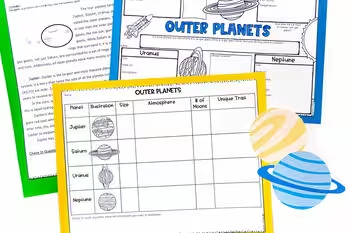
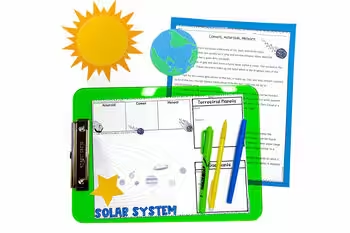
Once students know the sun is at the center, it’s time to sort the planets. Instead of asking students to memorize facts about all eight planets, have them look for patterns.
What do Mercury, Venus, Earth, and Mars have in common? How are Jupiter, Saturn, Uranus, and Neptune different from them? Graphic organizers help students compare terrestrial planets and gas giants side by side, so the differences actually stick. They’re also a big help for students who struggle with longer readings. Here are more ideas for graphic organizers that help struggling readers.
Try this jigsaw: divide the class into 2 groups, inner planets and outer planets. Each group reads about their planets, records the key characteristics on chart paper, and then teaches the other group what they learned.
3. Turn Your Classroom Into the Solar System With Planet Banners
Students remember what they see every day. Hanging a banner for each planet around your room keeps the solar system in front of students for the whole unit, and it gives you a ready-made reference for every lesson.
Each of my planet banners includes the planet’s distance from the sun, whether it’s terrestrial or a gas giant, its size, composition, atmosphere, number of moons, temperature, rotation, and orbit.
Planet banners are also a great option for the busy weeks between Thanksgiving and winter break. Not every school celebrates the holidays, so it helps to have engaging, low-prep science that isn’t holiday themed but still feels special.
Ways to use the banners:
Planet scavenger hunt: students walk the room to answer questions like “Which planet has the most moons?” or “Which planet takes the longest to orbit the sun?”
Put them in order: have students line up the banners by distance from the sun, size, or temperature, then explain any patterns they notice.
Research project: use the blank templates so students research a planet and build their own banner. A grading rubric is included.
Want the planet banners for your classroom? They’re free when you sign up below!
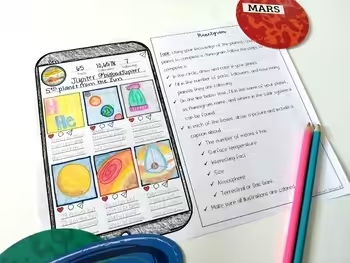
This is the activity my students always ask about. In the Planetgram project, students choose a planet and create a mock social media profile for it.
To build their planet’s profile, students research and include its:
surface temperature
atmosphere
number of moons
size
a unique trait
whether it’s terrestrial or a gas giant
It works as a fun end-of-unit assessment because students have to show what they know about their planet, and they put a lot more effort into it than a regular test! The project comes with a graphic organizer, student directions, a sample project, full- and half-page templates in print and digital formats, and a rubric.
Before the test, give students a review that feels more like a game than more practice.
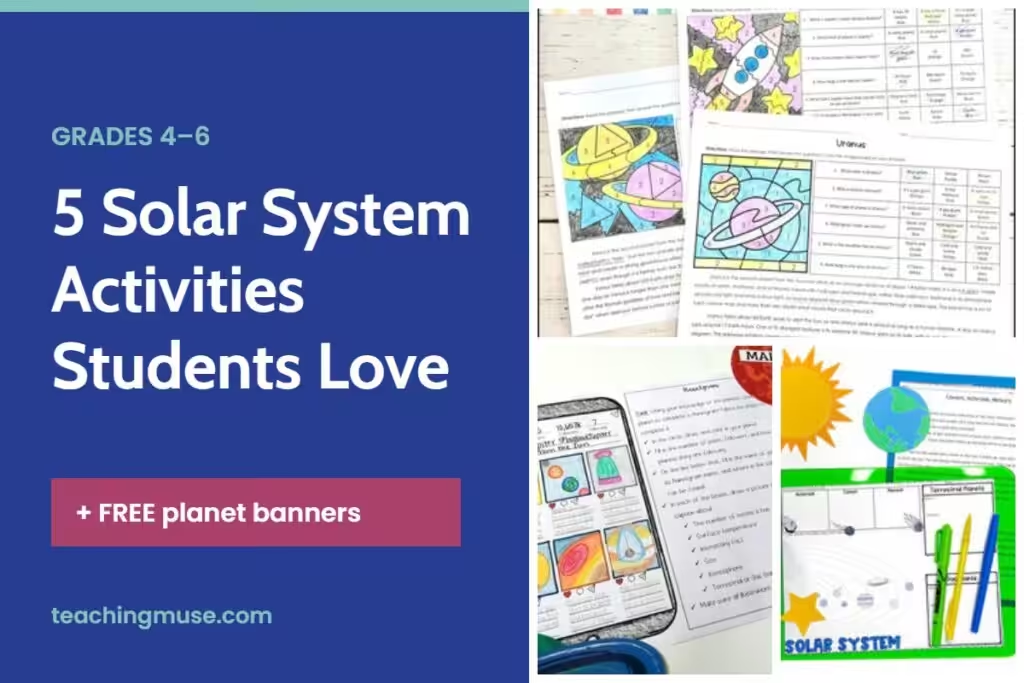
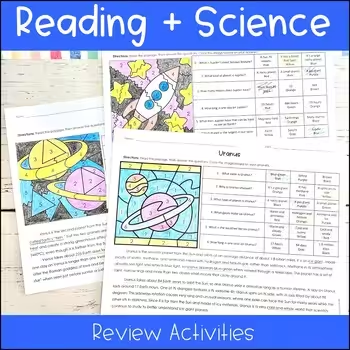
My solar system color by number reading pages include a short reading about each of the 8 planets. Students answer the questions, find text evidence, and then use their answers to color. A crossword puzzle and word search are included too.
They’re perfect for review days, early finishers, homework, and science sub plans, because students can complete them on their own.
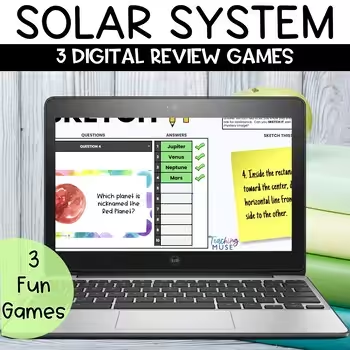
Prefer something digital? These solar system digital review games include three Google Sheets games: Sketch It, Custom Cars, and Compound Conundrum.
Each time students correctly answer a question about the planets, comets, asteroids, or meteors, they unlock the next part of a picture or puzzle. They’re already set up, so you only need to assign them.
If you’d like the readings, graphic organizers, Planetgram project, and a review game all in one place, check out my Solar System Unit bundle. Teachers have given it 4.8 stars from 57 ratings, and you’ll save compared to buying each resource on its own.
A solar system unit doesn’t have to be a list of planet facts. Start with a debate, look for patterns between the inner and outer planets, surround students with planet banners, let them get creative with a Planetgram, and finish with a fun review.
Looking for more space science ideas? Check out these posts: