Don’t Make This Mistake When You Teach Earth Science
There’s one mistake nearly every new teacher (and let’s be honest—plenty of veteran ones) makes when they teach Earth science:
👉 They teach each unit in isolation.
And while it’s tempting to tackle the rock cycle, moon phases, or weather systems like they’re stand-alone topics, this approach does a real disservice to both students and teachers.
Let’s break down what this mistake looks like, why it happens, and how to avoid it so you can teach Earth science in a way that’s cohesive, connected, and confidence-boosting.
1. The Mistake: Teaching Earth Science Like a Check-List
You check off one topic after another, hoping your students remember what you covered in September by the time testing rolls around in April.
But here’s the truth: Earth science is a web of connected systems. Teaching it as isolated facts or chapters makes it harder for students to see the big picture—and harder for you to build lessons that stick.
There’s pressure to “cover it all” before state testing
Earth science spans such a wide range of topics, that it feels disconnected
If you’re teaching weather one month and space the next, it’s natural to treat them as separate worlds. But doing so limits students’ understanding of Earth as a system of systems—which is exactly what NGSS wants students to grasp.
3. The Fix: Teach Earth Science With Systems Thinking
The secret? Stop teaching isolated units. Start teaching interconnected systems.
Show students how:
The movement of Earth’s plates shapes landforms and causes earthquakes
Erosion changes the Earth’s surface and affects habitats and human life
Earth’s rotation controls both day/night cycles and influences weather patterns
Gravity connects tides, planetary motion, and atmospheric layers
When you teach Earth science with systems thinking in mind, students build deeper understanding—and you spend less time reteaching later.
4. Tools to Help You Teach Earth Science With Confidence
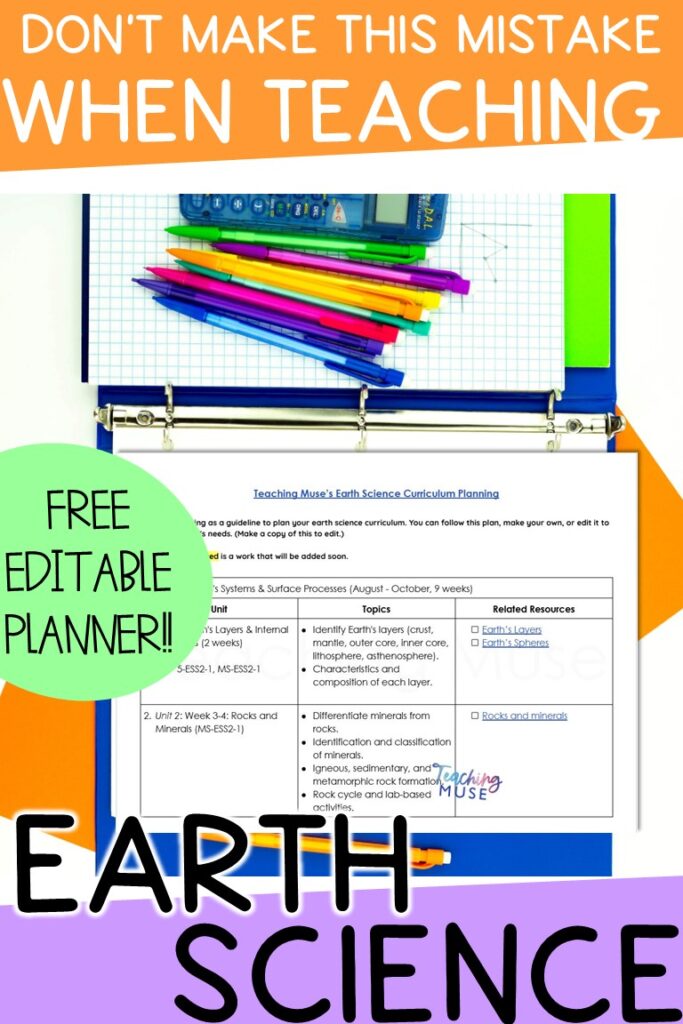
If you’re tired of piecing together lessons that don’t quite connect, you’re not alone. That’s why I created my Earth Science Curriculum Map—a free download that shows you how to sequence your units, highlight crosscutting concepts, and teach Earth science with more clarity and less chaos.
It’s everything you need to stop guessing and start teaching Earth science the way it was meant to be taught: with curiosity, connection, and confidence.
Teach Earth Science Like a Scientist, Not a Checklist
The biggest mistake isn’t forgetting to mention the mantle or skipping over weathering. It’s teaching Earth science as a bunch of disconnected trivia.
But once you start showing students how everything connects—rocks, weather, oceans, even the stars—you’re no longer just checking off boxes. You’re helping them understand the planet they live on.