
If you’ve taught CER before, you probably already know where students tend to get stuck.
The claim? Usually not too bad.
Finding evidence? They can normally do that with some practice.
But then you get to the reasoning.
Suddenly, students are repeating their evidence, restating their claim, or writing something like, “This evidence proves my claim is correct.”
Technically, they wrote something in the reasoning section, but we both know they didn’t actually explain their thinking.
This is one of the biggest struggles I see with CER, and I know I’m not alone. When I recently asked science teachers what their students struggle with most when writing CER responses, reasoning came up again and again.
So, why is CER reasoning so difficult for students? And more importantly, how can we help them get better at it?
Why Is CER Reasoning So Hard for Students?
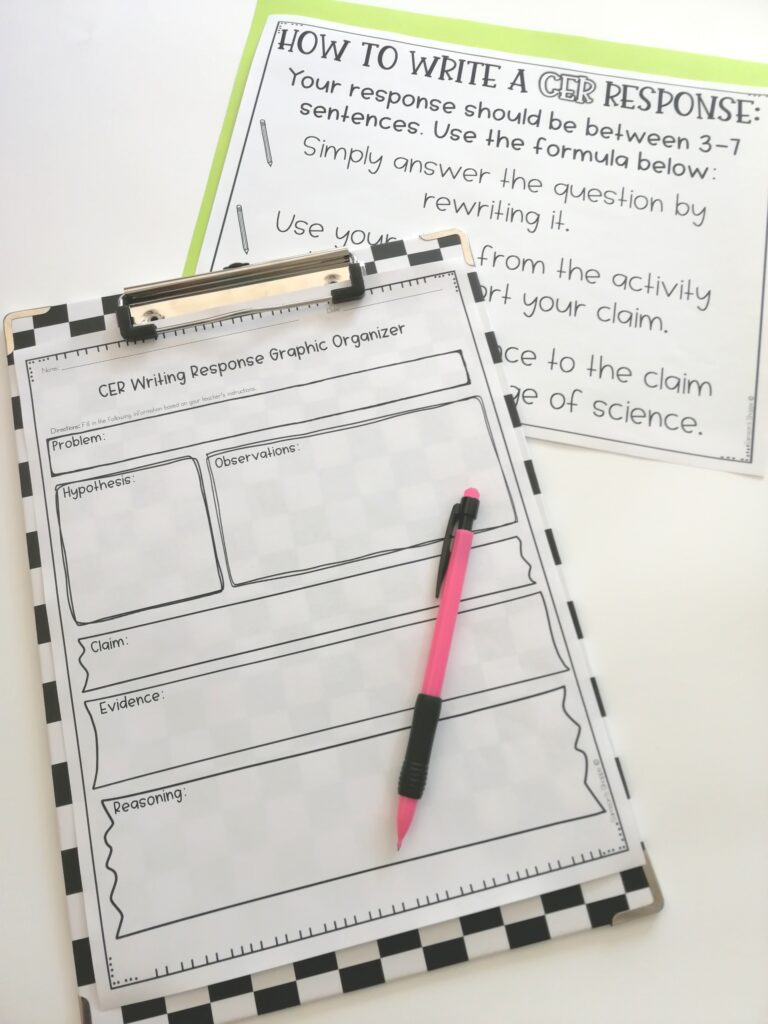
I think part of the problem is that evidence and reasoning feel like the same thing to students.
They found evidence that supports their answer. Why do they need to explain it again?
As adults, we automatically make connections between information and what it means. Students don’t always do this yet. Even when the connection seems obvious to us, they may not understand how to put that thinking into words.
That’s why we end up with reasoning like:
“The data shows that Plant A grew the most, so my claim is correct.”
The student has gone back to the evidence, but they haven’t explained why the evidence supports the claim.
That missing “why” is what we need to help them see.
Evidence vs. Reasoning in CER: What’s the Difference?
One of the simplest ways I’ve found to separate evidence and reasoning is to think about them this way:
Evidence = What do you see?
Reasoning = What do you know about science that explains what you see?
Evidence comes from the information students were given. It might come from:
- data in a table
- a graph
- observations from an investigation
- results from an experiment
- information in a reading
Reasoning is where students use what they know about science to explain why that evidence supports their claim.
Here’s a simple example.
Imagine students are trying to determine which material is the best insulator. They are given data showing how much the temperature of hot water changed when cups were wrapped in different materials.
Their claim might be: Wool is the best insulator.
Their evidence could be: The cup wrapped in wool had the smallest temperature decrease after 20 minutes.
So far, so good.
But this is where students often write: This proves that wool is the best insulator.
That isn’t really reasoning. They’ve basically just told us that their evidence supports their claim.
Instead, we want them to explain the science behind it: Insulators slow the transfer of thermal energy. Since the water in the cup wrapped in wool lost the least amount of heat, wool slowed the transfer of thermal energy better than the other materials.
Now we can actually see the student’s thinking.
A Question That Can Help Students With CER Reasoning
When students are stuck on reasoning, I like to bring them back to one question:
Why does this evidence matter?
They already told me what happened.
Now I want to know why what happened supports their answer.
You can also ask: What science idea explains these results?
That question is especially helpful because it reminds students that reasoning isn’t supposed to be another piece of evidence. They need to bring their science knowledge into the response.
For the insulation example, students need to know something about thermal energy and heat transfer to explain why the temperature data matters.
Without that science connection, they’re really just summarizing the results.
Show Students Weak and Strong CER Reasoning
We spend a lot of time showing students good examples, but I think there’s a lot of value in showing them examples that almost work.
Put two reasoning statements next to each other:
Example 1: The wool cup lost the least heat, so this proves wool was the best insulator.
Example 2: Insulators slow the transfer of thermal energy. The wool cup had the smallest temperature change, which shows that wool slowed heat transfer more effectively than the other materials.
Then ask: Which one is stronger? Why?
Students can usually spot the difference more easily when they aren’t trying to write the response themselves.
You can take this a step further and give students several reasoning statements to sort into categories like strong reasoning, needs more explanation, and not reasoning yet.
It gives them practice recognizing good reasoning before you expect them to consistently write it.

Keep Evidence and Reasoning Separate at First
It can also help to physically separate evidence and reasoning when students are first learning CER.
Instead of immediately asking for a polished paragraph, have students identify: What does the data tell me?
and then: What science concept helps explain that result?
Only after they can answer those two questions should they put everything together.
This slows the process down a little, but that’s the point.
Eventually, we want students to make those connections automatically. At first, though, they may need to see that evidence and reasoning are doing two different jobs.
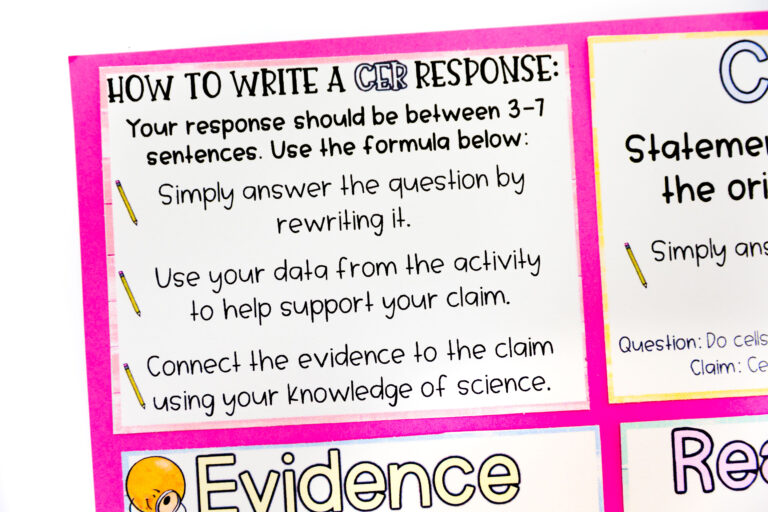
Use More Than Reading Passages for CER Practice
Reading passages can be a great way to introduce CER, especially when students are still learning how to identify evidence, but science gives us so many other ways to practice.
Students can make claims from:
- graphs
- data tables
- experimental results
- diagrams
- observations
- short scientific investigations
I especially like using data because students can clearly point to their evidence and then focus their attention on explaining what that data means.
It also helps CER feel more like science and less like another writing assignment.
For example, instead of reading a passage about plant growth, students might look at a graph showing the growth of plants given three different fertilizers.
They can identify which fertilizer produced the greatest growth.
That’s the easy part.
Then comes the important question: What does the data tell you, and why does that support your claim?
Now they have to do something with the evidence instead of just finding it.
Sentence Starters Can Help, But They Aren’t the End Goal
Sentence starters can be really useful when students are first learning CER.
For reasoning, you might use starters like:
- This evidence supports my claim because…
- Scientifically, this makes sense because…
- This result can be explained by…
But I don’t want students relying on those forever.
A sentence starter can help a student begin the reasoning, but it can’t do the reasoning for them.
As students become more comfortable, start removing some of that support and ask them to explain the connection in their own words.
That’s when you can really see whether they understand the science behind their answer.
CER Reasoning Takes Practice
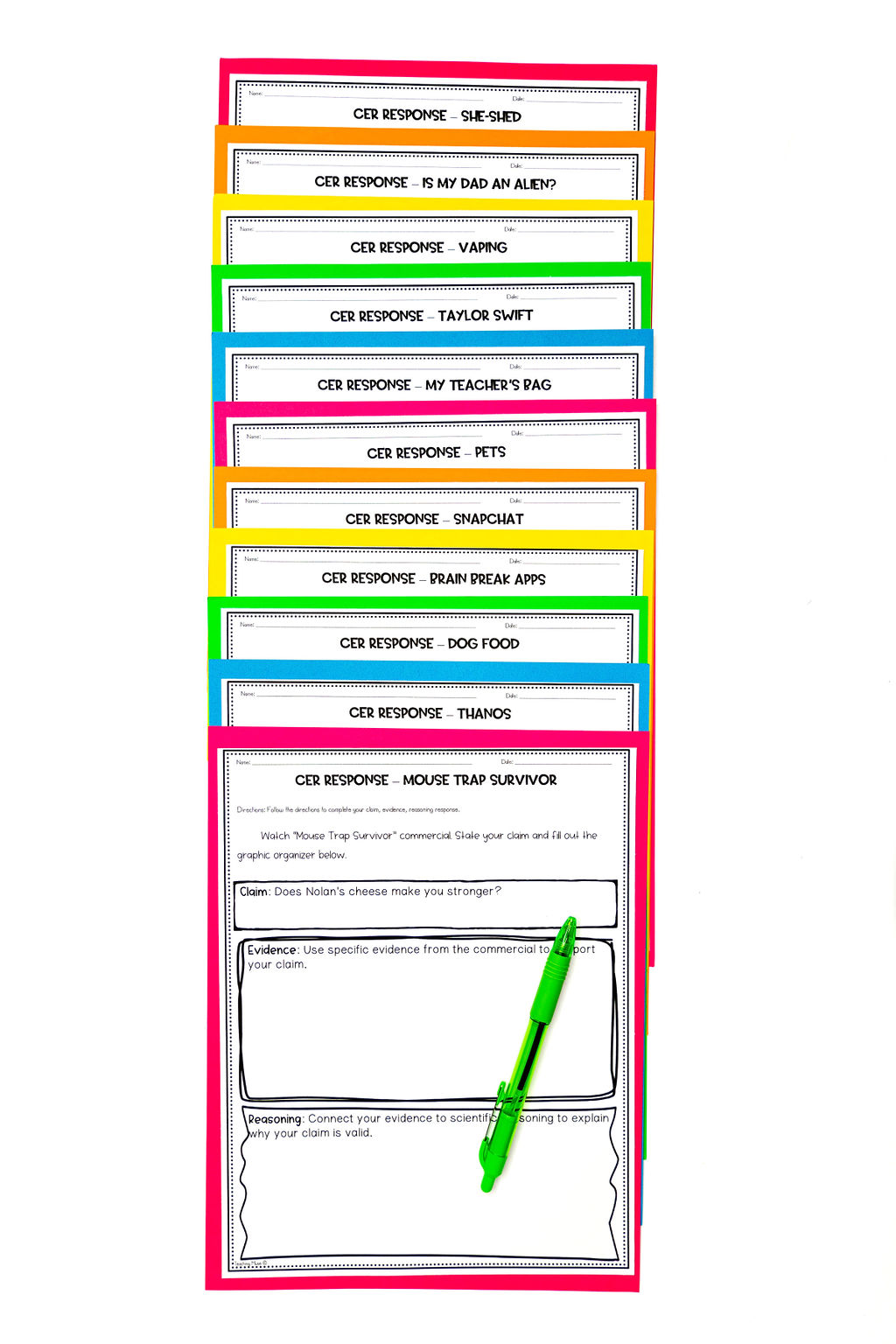
If your students are struggling with reasoning, doing one CER activity probably isn’t going to fix it. This is a skill they need to use again and again.
The good news is that every practice opportunity doesn’t need to mean writing a full CER paragraph.
Put a graph on the board and ask students to explain why one piece of data supports a claim. Give them a weak reasoning statement and ask them to improve it. Have students compare two responses and decide which one does a better job of connecting the evidence to the claim.
Those small opportunities add up.
The goal is for students to stop thinking of reasoning as, “I already gave you my evidence, so now I need to say it again.”
Instead, I want them thinking: I gave you my evidence. Now I need to explain why it matters.
And that shift doesn’t happen overnight. If your students are repeating their evidence or struggling to explain their thinking, keep breaking those two pieces apart. Ask them what the evidence shows, and then ask them what science they know that can explain why it matters.
Over time, that connection starts to become much more natural.
Looking for More CER Practice?
If your students need more practice with claim, evidence, and reasoning, I have CER resources designed to help students work through each part of the process without you having to create examples from scratch.
I’m also adding new ways for students to practice CER using graphs, data tables, and scientific investigations, so they can apply the same thinking to the types of evidence they actually encounter in science.
Check out my CER Resources HERE!
And if you’re just getting started with CER, you can also read Use CER Writing Strategy With Your Science Lessons for more ideas on introducing and using CER in your classroom.