
Let’s be real—traditional word walls just aren’t cutting it in a middle-grade science classroom.
Sure, they look cute. Maybe they make your admin think you’re crushing the literacy game. But do your students actually use them? Are they really helping kids understand and retain science vocabulary?
Spoiler alert: Nope.
If you’ve ever pointed to the wall mid-lesson and gotten nothing but blank stares, you know exactly what I mean. Learn strategies to tackle science vocabulary activities that will get your students to actually understand its meaning.
Why Word Walls Fall Flat in Science
Word walls might work fine in primary classrooms, but upper elementary and middle school students need more than laminated cards taped to a wall. Science vocabulary is complex. It’s abstract. And it often requires diagrams, examples, and multiple exposures to stick.
That’s why I ditched my word wall—and I’m not looking back.
So What Science Vocabulary Activities Should You Do Instead?
Let me introduce you to science vocabulary activities that actually work—and don’t take forever to prep.
Here’s what I use instead of a word wall:
One of the easiest science vocabulary activities to help students make connections between terms, visuals, and definitions is through the use of graphic organizers. My go-to organizer includes:
Definition
Synonym/Antonym
Visual representation
Real-world example
👉 Want to try it? Check out my science graphic organizer activities here.
These are hands-down one of my favorite alternatives to a word wall. Instead of having words just hang around on the wall gathering dust, these vocabulary trading cards get words into your students’ hands.
Students:
Fill in their own definitions and examples
Illustrate the concept
Trade cards to review vocabulary with partners or small groups
They work beautifully for:
Warm-ups
Review games
Exit tickets
🎉 Click here to grab the free vocabulary trading cards and watch how quickly your students start using science terms like pros.
3. Word Work Stations
Science vocabulary activities can be reviewed by getting kids working together with words to understand their meaning. Set up simple stations with low-prep tasks like:
Matching vocabulary terms to diagrams or definitions
Creating context sentences
Sorting by concept or category
They’re perfect for bell ringers, early finishers, or even when a lesson ends early.
4. Vocabulary in Action
Here’s where it gets fun. Instead of copying definitions from a textbook, science vocabulary activities like this let students use vocabulary in meaningful ways:
Build concept maps
Debate using academic vocabulary (hello, “photosynthesis smackdown”)
Need more ideas? I walk through tons of strategies in my blog post on How to Teach Science Vocabulary Effectively.
5. Digital Vocabulary Slides
Take your word wall into the 21st century and get interactive science vocabulary. Use Google Slides to create interactive vocab decks, and students build out:
Term
Image
Student-friendly definition
A quiz question they write themselves
They love the ownership and creativity—and bonus: it doubles as a study tool!
Want It All Done for You?
If your to-do list is already six miles long (because of course it is), don’t stress. I’ve bundled all these ideas into ready-to-go Science Vocabulary Activities on TpT—perfect for 4th-8th grade science.
Inside, you’ll find:
Final Thoughts: Say Goodbye to the Dead Word Wall
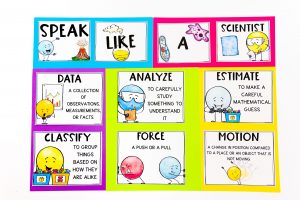
Science vocabulary is tough. But just because it’s tough doesn’t mean your students can’t master it. They just need something better than a bunch of unused cards taped to a bulletin board.
✅ Make vocabulary active.
✅ Make it visual.
✅ Make it meaningful.
✅ And give your students tools they’ll actually use.
Science Vocabulary FAQs
How to make science vocabulary fun?
Incorporate interactive science vocabulary activities such as games, flashcards, and hands-on experiments to engage students and enhance retention of scientific terms.
What are 5 vocabulary words for science?
Five essential science vocabulary words include hypothesis, cell, ecosystem, force, and matter, which are foundational for understanding various scientific concepts.
How to teach scientific vocabulary?
Teach scientific vocabulary using diverse science vocabulary activities, including multimedia resources, collaborative group work, and context-based learning to facilitate comprehension and application of terms.
Grab Your Free Vocabulary Trading Cards
👉 Want to try this strategy for free? Download the science vocabulary trading cards here and see how quickly your students start using academic vocabulary with confidence.