If you’re looking for a high‑interest, standards‑aligned science unit, look no further than teaching natural disasters unit. Students are naturally drawn to topics like earthquakes, tornadoes, and volcanoes—and these lessons are perfect for integrating literacy, NGSS practices, and critical thinking. This guide gives you six powerful strategies to make your unit engaging, educational, and safe.
1. Use a Real-World Phenomenon Hook
Begin your natural disasters unit with a compelling phenomenon—a real-world event that captures students’ attention and raises questions. This could be a video clip of a recent hurricane, a news story about wildfires, or even footage of a volcano erupting. The key is to create a moment of awe or urgency that naturally leads into student curiosity.
Once you show the video or present the article, pause and ask open-ended questions like:
What do you think caused this event?
How did it impact people or the environment?
Could this happen where we live?
Encourage students to jot down their initial thoughts in a science notebook or a shared discussion board. Their questions and observations can guide your unit’s direction and make them feel invested in discovering the science behind these powerful natural forces.
This strategy aligns perfectly with NGSS’s Science and Engineering Practice of Asking Questions and Defining Problems, and helps set a real-world context that will carry through your entire unit on teaching natural disasters.
When teaching a natural disasters unit, it’s essential to support all learners—especially ELLs and struggling readers—by previewing key vocabulary before diving into complex texts or activities. I like to introduce terms students will encounter throughout the unit early on. This simple step improves confidence and increases comprehension when they see these words again in context.
To reinforce understanding, revisit these vocabulary terms during reading. Encourage students to use context clues to define words naturally as they appear in informational texts or news articles. This not only strengthens their science literacy skills but also ties directly into reading standards.
For independent practice, I highly recommend using Quizlet, a free digital tool that offers a variety of engaging activities like flashcards, matching games, and quizzes. Students can review terms at their own pace and even challenge themselves with self-assessments.
By intentionally embedding natural disaster vocabulary throughout your lessons, you help students build scientific language and deepen their understanding of the unit’s core concepts.

3. Visual Hooks with Videos & Multimedia
Hook students by using videos. Whether it is a short video clip or a class period-long movie, our students are learning and gaining information through videos, so this allows them to learn on their terms. Some videos will cover the vast majority of natural hazards, or I may choose to show one type of disaster that we are studying. Below are some examples of videos that I feel are student-friendly and cover this topic well.
- Science of Natural Disasters
- Why Do Buildings Fall in Earthquakes?
- Elephants Warn of Tsunami
- Yellowstone Supervolcano
- Brainpop: Includes both a video on ALL types of natural disasters or one specific type of hazard. Brainpop videos require an account. They include short videos that pair information about scientific concepts down to student understanding. In addition, the activities included will also allow students to further their knowledge and cement their understanding of natural hazards.
- Dr. Binocs Show: Again, these are short videos that give a bite-sized amount of knowledge on a topic. I like to use them to introduce or review a concept.
- Natural Geographic: NatGeo has an excellent compilation of both videos and photos of natural disasters.
Of course, you can also find news and video clips of actual natural disasters that occurred on Earth. Showing these real videos will engage students as they can see and understand how devastating they are. In addition, many students will develop empathy skills as they witness the horrors that are left behind from these extreme weather phenomenons.
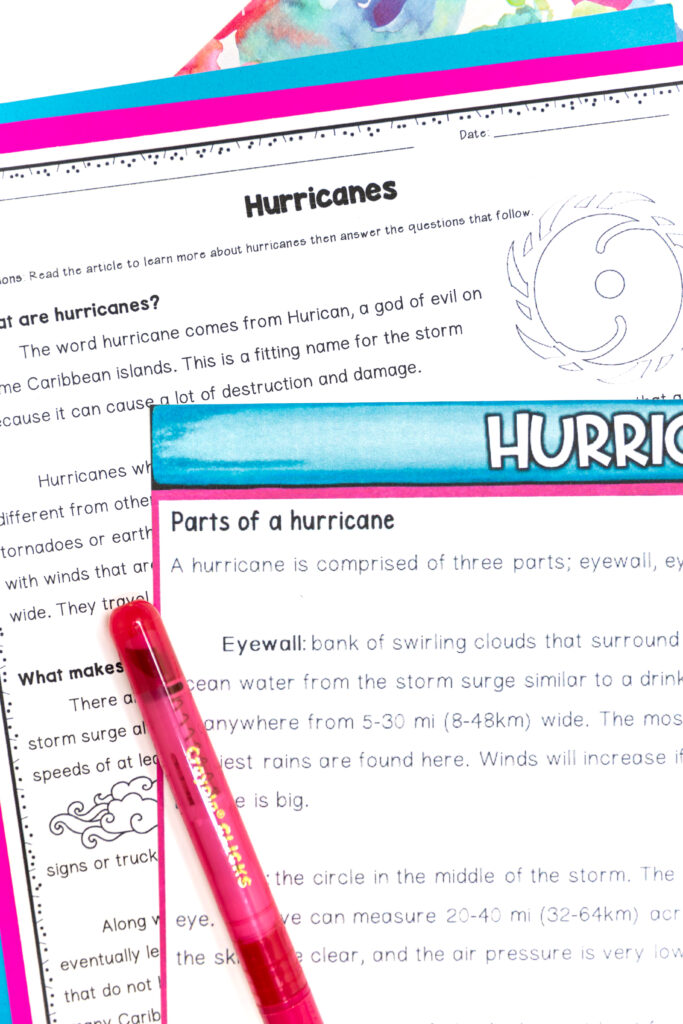
Reading and writing skills still need to be addressed in science class!
Infuse literacy skills into your science curriculum by providing students with science texts that they will use to anchor their understanding and learn more about natural hazards. Text can come from your natural disaster teaching resources such as your science curriculum, sites like NEWSELA, or you may be interested in testing my activities out.
Throughout teaching natural disasters unit, students will learn what natural hazards are, how they form, where the disaster will most likely occur, and safety precautions. To remain flexible in today’s teaching environment, printable and digital options are available.
5. Reinforcement Using Graphic Organizers
To further embed literacy skills and strengthen student knowledge of the topic, use graphic organizers with students. Graphic organizers can be used to:
- Summarize information about each natural disaster
- Compare and contrast natural hazards with one another
- Create a cause and effect chart to sequence how a natural disaster occurs or what a natural disaster will do to an area

6. Hands-On Engineering & Simulations: Bring Natural Disasters to Life
One of the best ways to make your natural disasters unit engaging and memorable is by incorporating hands-on STEM activities that simulate real-world disaster scenarios. These engineering challenges allow students to apply what they’ve learned while building problem-solving and collaboration skills.
Try one or more of the following interactive lessons:
Hurricane-Proof Structures: Give students building materials like toothpicks, paper, tape, or straws and have them design homes that can withstand simulated wind (a fan or blow dryer works great!).
Mini-Volcanoes: Use baking soda and vinegar to model volcanic eruptions while discussing magma, lava, and plate boundaries.
Tsunami Challenge: Test different materials that can withstand the impact of waves created from a tsunami.
Earthquake Shake Table: Use cardboard, rubber bands, and marbles to simulate tectonic movement and test structure stability.
- Students should determine what natural disasters can happen where they live and what measures should be taken to reduce the amount of damage to homes and businesses.
These simulations tie directly into NGSS engineering standards and keep students active, invested, and thinking like scientists.
Address Student Misconceptions About Natural Disasters
Before wrapping up your unit, take time to identify and correct common misconceptions students may hold about natural disasters. These misunderstandings can block deeper comprehension if left unaddressed while teaching natural disasters unit.
Some common misconceptions include:
“All natural disasters are caused by weather.”
→ Clarify the difference between geological disasters (earthquakes, volcanoes) and weather-related ones (hurricanes, floods).“Stronger earthquakes always create tsunamis.”
→ Explain the specific conditions needed for a tsunami to form.“Natural disasters only happen in other places.”
→ Use real data to show how local areas may be affected by floods, wildfires, or storms.“Humans can’t influence natural disasters.”
→ Discuss how human activity (e.g., climate change, deforestation) can increase the frequency or severity of certain disasters.
Use class discussions, reflective journal entries, or a “myth vs. fact” activity to address these misconceptions and reinforce accurate scientific understanding.
Check out these ready-made natural disaster lessons: