

Feeling overwhelmed by how much science you’re expected to teach this year?
You’re not alone… and you’re not a bad teacher for feeling stuck.
Many teachers struggle to figure out which 5th grade science units to teach in depth and which ones are better suited for short lessons or light review. This post will help you confidently make that call, while avoiding burnout by trying to do too much.
Why You Can’t Go Deep on Every Unit
NGSS 5th grade science emphasizes deep understanding, modeling, and real-world application. That means teaching a few units thoroughly is more effective than rushing through all of them superficially.
But how do you decide which 5th grade science units to teach in depth?
That’s where a strategic Deep vs. Wide approach comes in, and it starts with a few key questions.
How to Choose 5th Grade Science Units to Teach in Depth
Here are five questions to help you decide which 5th grade science units deserve your time and focus.
1. Does the unit support a core NGSS performance expectation?
Prioritize standards that are foundational, often spiraled, or critical for building future understanding.
✅ Example:
Ecosystems and energy flow (5-LS2-1) is a high-impact unit that’s worth teaching in depth.
2. Can this unit support modeling, CER writing, or investigation?
If a unit allows for hands-on inquiry, explanations, or student-led thinking, it’s a great candidate for deep instruction.
✅ Example:
Earth’s spheres and systems (5-ESS2-1) is perfect for modeling and analysis.
3. Is this a concept students typically struggle with?
If your past students have had difficulty grasping a topic, spend more time on it.
✅ Example:
Properties of matter (5-PS1 series) often requires more exploration and concrete connections.
4. Do you already have strong materials for this unit?
If you have lessons, labs, or resources that support deeper learning, use them! Going deep doesn’t have to mean starting from scratch.
✅ Example:
-
- My Ecosystems Unit is packed with CERs, readings, and modeling activities that make deeper teaching easier.
5. Does this unit connect to other topics or real-world issues?
Choose units that let students make cross-curricular or real-world connections. Typically, students will be more engaged and they’ll be able to relate to the world around them.
✅ Example:
-
- Human Body Systems can connect to health, nutrition, and environmental impact, making it an ideal deep-dive topic.
When It’s Okay to Go Wide
Not every unit needs multiple weeks of lessons and labs. Some 5th grade science units are best taught with brief exposure, review, and reinforcement throughout the year.
Go wide when:
-
- The concept is visual, observational, or not easily modeled
-
- You have limited class time
-
- It makes more sense to revisit the topic later
✅ Example:
-
- Stars and constellations (5-ESS1-2) is best taught with a reading, diagram labeling, and discussion — then touched on again during astronomy review.
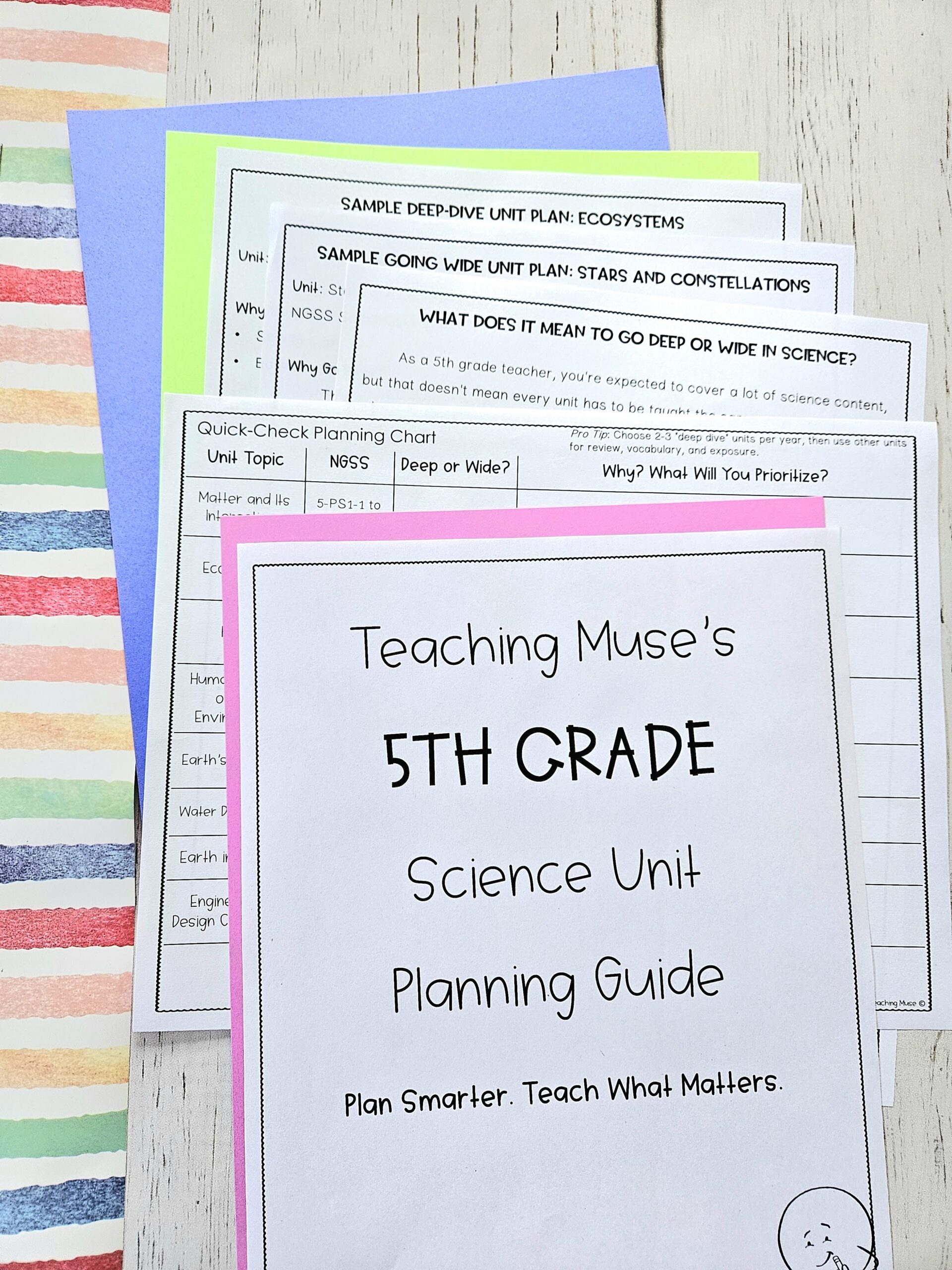
Download Your Free Planning Guide
Still feeling unsure about how to prioritize your science units?
Grab my free Deep vs. Wide 5th Grade Science Planning Guide. You’ll get:
-
- A clear explanation of what it means to teach a unit deeply vs. widely
-
- Sample NGSS-aligned units for both strategies
-
- A printable planning chart to organize your year
Want the Hard Part Done for You?
If you’d rather not spend hours deciding where to go deep or wide, my 5th Grade Science Curriculum Map + Full-Year Bundle already does the heavy lifting.
You’ll get:
-
- NGSS-aligned units clearly organized by quarter
-
- Ready-to-teach deep-dive units
-
- Lessons, activities, readings, assessments, and more
-
- A structure that helps you teach what matters — without the overwhelm
👉 Check out the 5th Grade Science Curriculum here!
Final Thoughts
Choosing which 5th grade science units to teach in depth doesn’t have to feel like guesswork. With a little strategy and a clear planning guide, you can teach more confidently, focus on what matters, and give your students better science experiences.
And hey, you’re already doing a lot. Let this framework lighten your load.
👉 Download the free planning guide and start building a smarter science year today.


