How to Use Spiral Review in Science (and Actually Help Students Remember)
If you’ve ever stood in front of your class and thought, “Didn’t we already learn this?” — welcome to the club. Science concepts fade fast when students only see them once. That’s where science spiral review, or what I call Flashback Friday, saves your sanity.
The Science Behind Spiral Review in Middle School Science
Here’s the deal: the human brain is wired to forget information it doesn’t use often. Psychologists call this the forgetting curve — within weeks, students lose up to 80% of what they’ve learned if it isn’t revisited.
However, when we practice spaced over time and interweave old concepts with new ones (two well-researched learning strategies), retention skyrockets.
In other words:
The more often students recall and apply old information, the stronger their understanding becomes.
Spiral review is simply putting the science of learning into practice, intentionally revisiting prior topics while connecting them to current units.
Recognize patterns across Earth, Life, and Physical Science.
Build genuine understanding instead of memorized fragments.
Easy Spiral Review Activities and Bell Ringers for Science
Here’s the good news: science spiral review doesn’t mean reteaching everything from scratch. You just need short, consistent routines that keep concepts alive.
1. Flashback Friday Bell Ringers
Spiral review doesn’t have to be another prep task; it can fit right into what you’re already doing.
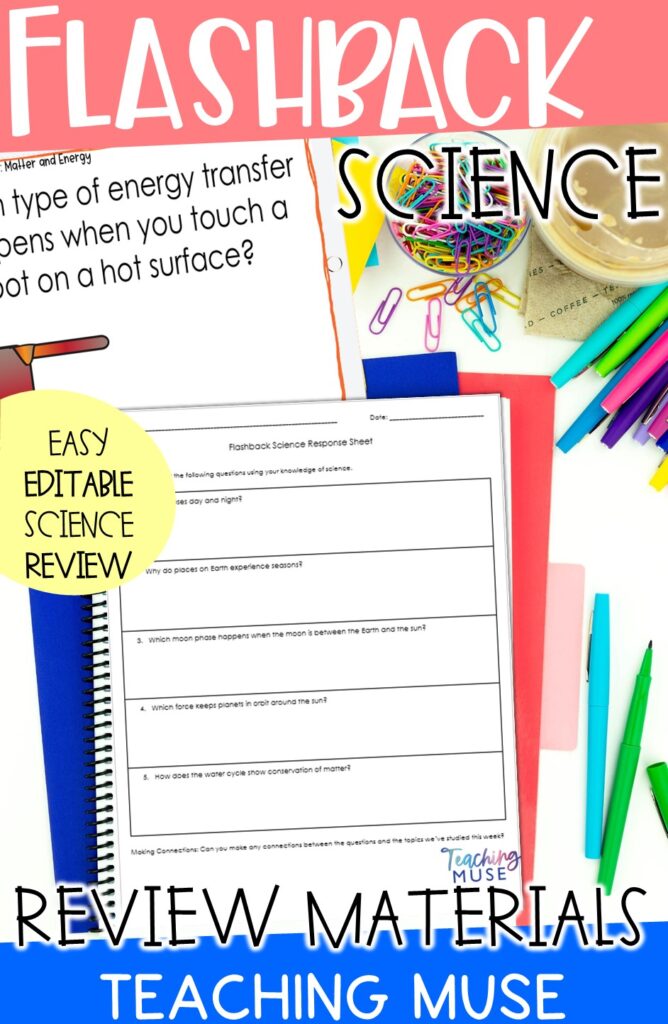
Try adding a Flashback Friday routine: 3–5 short science review questions at the start of class. These bell ringers pull from past topics (Earth, Life, and Physical Science) and remind students that science builds on itself.
Students answer in their science notebooks or a “Flashback Journal,” and you review together in 5 minutes flat.
This consistent routine gives students the spaced retrieval practice their brains need to actually retain information — and it gives you the perfect low-prep Friday opener that reinforces NGSS concepts all year long.
Pro tip: Color-code by domain — Blue for Earth 🌎, Green for Life 🌿, Orange for Physical ⚡️, Purple for Science Skills 🧠 to build recognition and variety.
2. Exit Tickets that Circle Back
Turn ordinary exit tickets into a built-in science spiral review system. At the end of a new lesson, add one “throwback” question from a past topic that encourages students to apply old knowledge in a fresh context.
Example: after teaching weather fronts, include “How does energy transfer relate to the formation of a cold front?”
This strategy helps students see that science builds on itself rather than being a series of unrelated chapters. Over time, these small checks create meaningful review opportunities and help you spot misconceptions before they stick.
3. Quarterly “Connections” Challenges
Every few weeks, dedicate part of a class period to a Connections Challenge.
If your students use interactive notebooks, dedicate a “Flashback Section” for weekly review questions.
Each Friday, students record their answers and color-code connections to previous topics.
Over time, this section becomes a visual record of learning and a ready-made study guide for benchmarks or state tests. By turning science spiral review into a living part of the notebook, you create a powerful portfolio that tracks growth across all NGSS strands.
Ready to Try It?
You don’t need to reinvent the wheel. I’ve done the work for you.
Grab my Free 4-Week Flashback Friday Science Bell Ringers for grades 5–8.
They’re color-coded by topic, aligned with NGSS, and ready to project or assign in Google Slides.
When you’re ready for a full year of sanity-saving spiral review, check out the Flashback Friday Science Bell Ringer Bundle — 40 weeks of NGSS-aligned questions that keep knowledge fresh and brains firing.
Science understanding fades fast, but with a five-minute weekly routine, you can help your students actually remember what they learned.
Spiral review isn’t busywork. It’s brain science in action — and your future self (and your students’ test scores) will thank you for it.